


 Sorry! We may not have that brand right now, but we’re always adding to our collection. Check back later.


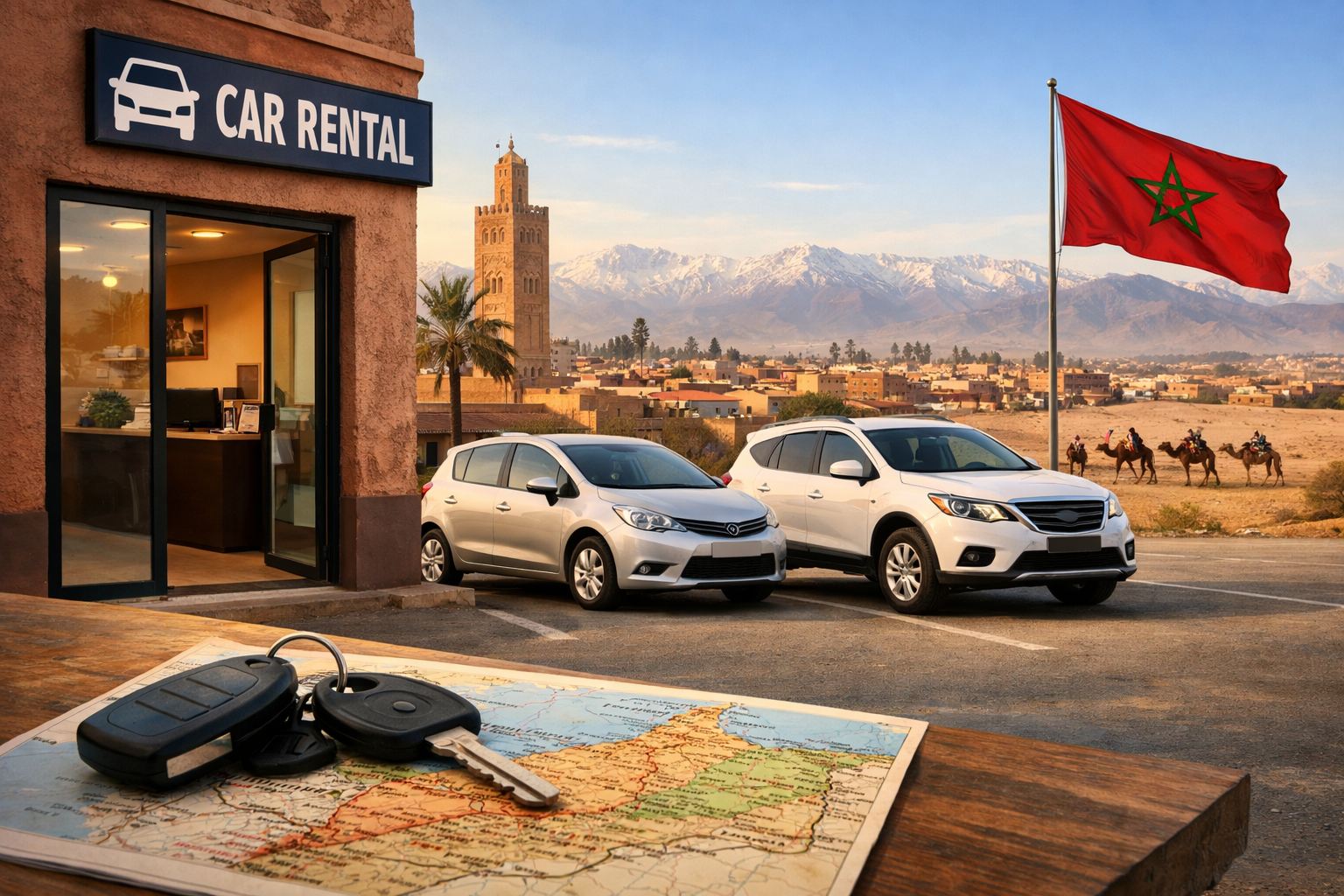
Every summer, the airports of Mohammed V, Marrakech Menara, and Ibn Battuta in Tangier transform into non-stop beehives of activity. Queues of travelers searching for car keys waiting outside arrival halls. Moroccans living abroad wanting to move freely between their hometowns and coastal cities, and European tourists dreaming of driving through the High Atlas roads all the way to the Sahara. This scene is no exaggeration, it is the reality of a market where the number of tourists arriving in Morocco reached nearly twenty million visitors in 2025 alone, a historic and unprecedented figure that made the Kingdom the top tourist destination on the African continent.
Behind these staggering numbers stands the self-drive car rental sector as one of the hidden pillars driving the tourism machine. You cannot imagine a tourist landing in Marrakech wanting to visit Essaouira or Ouarzazate without passing through a car rental agency. And you cannot imagine a company organizing international events without a ready fleet of vehicles. The demand is real, large, and growing, and this is precisely what attracts the interest of thousands of young Moroccans and investors every year.
But, and here is the crux of the matter, entering this sector is no longer what it used to be a few years ago. Since April 2024, a new specifications charter (cahier des charges) came into force, completely redrawing the rules of the game. The details I will present here are not merely a dry reproduction of legal texts, but the essence of an in-depth analysis of what each condition means in practical terms, and how a new investor can intelligently navigate each obstacle.
A Quick Overview of the Car Rental Sector in Morocco
To understand the scale of the opportunity, one must look back a little. The self-drive car rental sector in Morocco is relatively old, but has undergone radical transformations over the past decade. What changed is that economic openness and the meteoric rise in the number of tourists and Moroccans residing abroad, who number several million annually, opened the appetite of small and medium investors to enter the sector. Local agencies proliferated rapidly, especially in Marrakech, Casablanca, Agadir, Tangier, and Fes.
The problem is that this rapid expansion was not always organized. Unhealthy practices emerged: agencies without adequate insurance, dilapidated vehicles, unclear contracts, and individuals entering the sector with weak financial deposits who then found themselves unable to repay their debts to car distributors. All of this pushed the Ministry of Transport and Logistics to act and restructure the sector from its roots.
The Legal Framework: What Actually Changed After 2024?
Let’s be candid: before April 2024, there was an old specifications charter that did not keep pace with a market that was changing approximately every six months, in the words of a prominent professional in the sector. The legal texts lagged behind actual practice, which created a vacuum that some exploited to operate in questionable ways.
On the ninth of April 2024, the Minister of Transport and Logistics, Mohammed Abdeljalil, signed the new specifications charter, which came into force starting April 15, 2024. This charter came after marathon discussions between the Ministry, unions, and professional associations, and carried within it fundamental amendments affecting virtually all aspects of the activity.
The most notable provisions of the new charter can be summarized in several main axes: raising the required number of vehicles, tightening conditions for the manager, precisely defining the minimum capital, imposing standards for the registered premises, and setting transitional periods for existing agencies. The charter also included an important expansion of the scope of activity to include motorcycles alongside cars.
Agencies that were operating before the new charter came into force were granted a transitional period extending until the end of March 2025 to meet the conditions related to premises, the person responsible for the activity, and legal form. As for meeting the minimum number of vehicles, the deadline extends until March 2027.
Basic Requirements for Opening a Car Rental Agency – In Detail
Capital: Five Hundred Thousand Dirhams… And the Reality Is More
The first and clearest condition is capital. The new specifications charter requires a frozen amount in the bank of no less than 500,000 dirhams (50 million centimes). This amount must be proven by an official bank certificate submitted as part of the licensing application file.
But anyone who truly knows the Moroccan market understands that this amount is merely the theoretical minimum. In practice, you will need a much larger budget to cover the cost of the vehicles, shop rental, insurance, and initial expenses. Some professionals even called for raising this amount to 100 million centimes to reduce non-serious competition and protect the sector from adventurers.
Number of Vehicles: From 5 to 7 and Not Just Any Vehicles
This is one of the most prominent changes in the new charter. The minimum number of required vehicles rose from 5 to 7 cars. The objective of this increase is clear: to break with a practice that was very common, where some individuals obtained a license with only five cars, purchased them with minimal deposits and post-dated checks left with distributors, then after a few months found themselves unable to repay and declared bankruptcy.
In practical terms, these seven vehicles must be registered in the company’s name and have all documents: registration cards, valid technical inspection certificates, and insurance contracts. The agency may purchase used cars alongside new ones, provided the purchase is from another licensed car rental agency, with the used car subject to technical inspection.
Another important point: the new charter expanded the fleet to include all vehicles requiring category A1, A (motorcycles), and B (regular cars) driving licenses, meaning the agency can now also rent motorcycles, opening new horizons especially in tourist cities.
Premises and Registered Office: Not Just Any Location Will Do
The specifications charter requires the availability of an appropriate registered office suited to the nature of the activity. In practice, this means a commercial space of no less than 30 square meters as a minimum for the office, with a visible facade attracting potential customers. In addition, you need parking space, either a garage attached to the premises or nearby.
Choosing the location is a strategic decision par excellence. The most successful agencies in Morocco are those positioned near airports, train stations, and major hotels. In Casablanca, for example, you’ll find a large cluster of agencies on the road leading to Mohammed V Airport. In Marrakech, activity is concentrated around the Guéliz area and near the airport. In Tangier, the area surrounding Ibn Battuta Airport has become a prime destination.
Manager Conditions: The New Most Impactful Standard
Perhaps this is the aspect that many do not give sufficient importance to. The new specifications charter imposes precise conditions on the manager or legal representative of the agency and these conditions are not merely formalities but real and impactful:
In terms of qualifications, the requirement is a specialized technical diploma or a university studies diploma or their equivalent. In the absence of such qualifications, an educational level of no less than the final year of the Baccalaureate cycle is required, along with professional experience of no less than two years in the self-drive car rental field.
The fundamental change here is in how experience is proven: it is no longer sufficient for another professional to testify that you worked with them as was previously the case. It is now necessary to present a CNSS (National Social Security Fund) registration certificate as official proof of years of work in the sector. This procedure cuts off the path to the courtesy certificates that were easily granted.
There are also conditions related to the manager’s criminal record: they must not have been sentenced by a final judicial decision prohibiting them from engaging in commercial or industrial activity, nor convicted in serious cases such as terrorism, premeditated murder, human trafficking, breach of trust, money laundering, drug trafficking, smuggling, illegal immigration, and forgery.
Documents Required to Obtain the License

The licensing application file differs slightly depending on whether the applicant is a natural person or a legal entity (company).
For natural persons, the file includes: a request addressed to the Minister in charge of the transport sector, a certified true copy of the national identity card, a bank certificate proving the availability of a frozen amount of no less than 500,000 dirhams, a copy of the criminal record, and a copy of the educational certificate.
For companies (which is the most common form), the following are added: a copy of the company’s articles of association specifying self-drive car rental as a main activity, documents defining the manager’s powers and mandate, a copy of the commercial register certificate, a copy of the professional tax registration certificate, and a copy of the VAT registration certificate.
After obtaining final approval, the following must also be added: copies of vehicle registration cards for rental vehicles, copies of technical inspection certificates for each vehicle, copies of insurance contracts, and a premises inspection report by the relevant delegation services.
Steps to Obtain the License: Step by Step
The process passes through two essential stages that cannot be skipped:
Stage One: Preliminary Approval. Documents are deposited at the delegation of the Ministry of Equipment and Transport (transport sector) in the region where you intend to open the agency. This delegation studies the file and verifies that the basic conditions are met before giving the initial green light. Fees at this stage are free.
Stage Two: Final Approval. After obtaining preliminary approval, the practical procedures must be completed, purchasing vehicles, equipping the premises, concluding insurance contracts, then submitting the complete file to the Road Transport Directorate at the central level to obtain the final license.
In terms of timing, the process may take from three to six months in the best case, and sometimes more depending on the complexity of the file and administrative pressure. The golden advice here: prepare your file with extreme care from the first attempt, because any deficiency in a single document may delay you by additional weeks.
The Real Costs of Starting the Project: Figures from the Field
Many articles talk about 500,000 dirhams as a sufficient budget to start the project. But those who know the field know that this amount is merely the capital frozen in the bank, not the actual total cost.
The cost of purchasing vehicles is the heaviest item in the budget. Seven new economy cars (such as Dacia Logan or Hyundai i10) cost between 700,000 and 1,200,000 dirhams depending on the model and equipment. If you want a mix of economy and mid-range vehicles, it may reach one and a half million dirhams or more.
Rent for premises and garage varies drastically by city and location. In Casablanca or Marrakech at a good location near the airport, expect between 8,000 and 15,000 dirhams per month for the premises and garage combined. In smaller cities like El Jadida or Beni Mellal, you may find lower prices.
Vehicle insurance is an item that cannot be compromised. The cost of comprehensive insurance for one vehicle is approximately 2,600 dirhams per year as a minimum (for economy cars), meaning about 18,000 dirhams for seven vehicles. This amount rises significantly with more expensive vehicles.
Legal incorporation expenses include commercial register fees, accountant or lawyer costs for preparing the company’s articles of association, and tax registration fees. These usually range between 5,000 and 15,000 dirhams.
Add to this office equipment costs (furniture, computer, printer, phone), initial marketing (website, business cards, digital ads), and hiring at least one or two employees.
Frankly, a realistic budget for launching a car rental agency in Morocco in 2026 is no less than 1,500,000 to 2,000,000 dirhams if you want to start professionally and sustainably. Anyone who enters with less than that is taking a significant risk.
Challenges and Problems Nobody Talks About
First: Fierce competition. In cities like Marrakech and Agadir, the number of agencies has become very high, and prices are constantly declining due to price wars. Some agencies offer cars at 150-200 dirhams per day, a price that doesn’t even cover consumption and maintenance costs, just to attract customers away from competitors.
Second: The problem of checks and guarantees. In Morocco, there is no unified system yet to protect rental agencies from fraud. Some customers take the vehicle and disappear for weeks. The blank check as a guarantee, though a common practice, raises legal issues. The absence of a unified standard contract at the national level complicates the problem further, though the Ministry is studying the possibility of establishing one.
Third: Maintenance and accident costs. Rental vehicles are subject to intensive use and not all customers treat them with the same care. The bill for maintenance, repairs, tire changes, and spare parts consumes a large portion of the profit margin. One serious accident on a single vehicle can cost you more than what you earned from it throughout the year.
Fourth: Seasonality. Although Morocco has become a year-round tourist destination, there remains a significant variation in demand between summer (peak season where demand doubles) and the rest of the year’s months. In January and February, some agencies struggle to operate even half their fleet.
Fifth: Bureaucracy and administrative complexity. Dealing with different administrations (Ministry of Transport, commercial register, tax services) requires patience and continuous follow-up. The implementation of the new specifications charter created confusion at some delegations that were not fully prepared.
Sixth: Incomplete digitization. It is true that the Ministry of Transport launched an online information system, and professionals now obtain their vehicles’ registration documents without visiting administrative offices. But the road toward complete sector digitization is still long. Many procedures still rely on paper and personal presence, consuming valuable time that could have been invested in developing the business.
Seventh: Rising new car prices. Over the past two years, the Moroccan car market witnessed a notable price increase due to global factors (semiconductor crisis, rising shipping costs) and local ones. This increase raises the cost of entering the sector and extends the capital recovery period. Meanwhile, rental prices have not risen at the same rate due to competition, meaning greater pressure on profit margins.
Eighth: The legal challenge. the Federation of Car Rental Agency Associations warned in April 2025 that some provisions of the new specifications charter threaten the sustainability of small and medium-sized agencies. Some agencies face real difficulties in raising their capital to 500,000 dirhams and expanding their fleet to 7 vehicles within the specified deadline.
Is the Project Actually Profitable in 2026? An Analysis in Numbers
Let’s take a realistic scenario: an agency owning 7 economy cars with an average rental price of 300 dirhams per day.
Optimistic scenario (70% occupancy rate, i.e., the car rented 21 days out of 30): Monthly income = 7 × 300 × 21 = 44,100 dirhams After deducting expenses (rent 10,000 + salaries 10,000 + insurance 1,500 + maintenance 5,000 + fuel and miscellaneous 3,000) = approximately 29,500 dirhams in expenses. Net approximate profit = 14,600 dirhams per month.
Realistic scenario (50% occupancy rate): Monthly income = 7 × 300 × 15 = 31,500 dirhams With approximately the same expenses, the net profit remains weak, not exceeding 2,000 to 5,000 dirhams, and may record losses in some quiet months.
The conclusion: The project is profitable, yes but not with the ease many imagine. Real profitability is achieved when you expand your fleet to at least 15-20 vehicles, diversify between economy, mid-range, and luxury, and build a strong reputation and commercial name that attracts customers without heavy advertising spending.
The major positive factor is that the horizon is promising: Morocco is preparing to host the 2030 FIFA World Cup in co-organization with Spain and Portugal, and this event will be a massive driver for the tourism sector and consequently for car rentals. Projections point to receiving 26 million tourists annually by 2030. Seven Moroccan cities will host World Cup matches: Casablanca, Rabat, Marrakech, Tangier, Fes, Agadir, and Benslimane. All these cities will witness an unprecedented boom in infrastructure, transport, and tourism. Those who enter the sector now and build a solid foundation will be in an excellent position to reap the fruits of this boom.

And do not forget that 2025 was exceptional by all measures: Morocco surpassed the threshold of one million tourists in January alone for the first time in its history and achieved record tourism revenues exceeding 124 billion dirhams through the end of November. These figures are not mere statistics, but a clear indicator that demand for mobility services including car rental will continue to rise.
Professional Tips for Success – From Inside the Market
One of the most important pieces of advice that can be given to anyone thinking about this project: do not start without real field research. Visit five or six agencies in the city you’re targeting. Talk to their owners if possible. Ask about actual occupancy rates and daily problems. Theoretical information is one thing and reality is quite another.
Second tip: Focus on digital presence from day one. Today, most customers especially foreigners and Moroccans abroad search online before their feet touch the airport ground. A professional website in three languages (Arabic, French, and English), an active Google Business profile, and presence on price comparison platforms like ours makes a big difference.
Third: Build relationships with hotels, travel agencies, and tour guides. These channels bring you customers continuously in exchange for a simple commission, reducing your dependence on paid advertising.
Fourth: Don’t compete on price alone. Price competition is a race to the bottom. Instead, differentiate through service quality: clean and well-maintained vehicles, warm reception, flexibility in delivery and return times, free GPS system, child seat on request. These small details are what make the customer return and recommend you to others.
Fifth: Always maintain an emergency fund. One accident or maintenance delay can cost you dearly. Experienced professionals recommend maintaining the equivalent of two months of expenses as a permanent reserve.
Sixth: Think about specialization. Instead of being a general agency competing across all segments, you can specialize in a certain category and become a reference in it. For example: specializing in luxury car rentals for business people and events in Casablanca and Rabat. Or specializing in 4×4 vehicles for desert adventures departing from Ouarzazate or Marrakech. Or even specializing in motorcycle rentals for tourists in cities like Essaouira and Agadir a new field opened by the specifications charter with wide space still available.
Seventh: Don’t neglect taxes and accounting. Many new agency owners focus on the commercial activity and forget the tax side, then are surprised by the accumulation of large amounts. Engage a specialized accountant from the beginning and ensure you are committed to tax declarations and social security contributions.
Eighth: Invest in training your team. The employee who receives the customer is the face of your agency. If they are polite, professional, and speak two or three languages, they are an asset of your company. Don’t hire just to fill a salary slot invest in training and quality.
Fatal Mistakes to Avoid
First and biggest mistake: Purchasing vehicles with post-dated checks without actual repayment capacity. This practice was the main reason for the bankruptcy of dozens of agencies in past years. The new specifications charter was created specifically to combat this phenomenon. If you don’t have sufficient money to purchase vehicles in cash or with genuine bank financing, do not gamble.
Second mistake: Cheap or insufficient insurance. Some agency owners choose the cheapest insurance offers to save money, then discover at the first accident that the coverage barely covers anything. Investing in comprehensive and strong insurance is an absolute necessity, not a luxury.
Third mistake: Neglecting regular maintenance. A vehicle that breaks down with a customer in the middle of the road doesn’t just harm you financially it destroys your reputation. In the age of online reviews, one negative Google review can cost you dozens of potential customers.
Fourth mistake: Not paying attention to the legal aspects of rental contracts. A clear and detailed rental contract protects both you and the customer. It must include all details: renter’s identity, vehicle specifications, rental period, price, deposit, conditions of use, liability in case of accidents, and signatures.
Fifth mistake: Ignoring the digitization of management. In 2026, you cannot manage a successful agency with a paper ledger. Digital fleet management systems help you track the condition of each vehicle, maintenance schedules, rental contracts, and income and expenses accurately. Investing in a good management software saves you many headaches.
A Final Word
The car rental market in Morocco is not just an ordinary business project. It is a living and dynamic sector, closely linked to the pulse of the economy, tourism, and market sentiment. Those who enter it with a quick-speculation mentality will leave with losses. Those who enter it with careful planning, a long-term vision, sufficient capital, and genuine market knowledge… will find in it a golden opportunity especially as Morocco is living through an exceptional phase of tourism growth in preparation for the 2030 World Cup and doubling its absorptive capacity.
The new specifications charter despite raising the entry ceiling is in reality a disguised blessing for serious professionals. Because it cleans the sector of adventurers and protects the market from the chaotic practices that were harming everyone. Those who comply with the conditions and work diligently will find themselves in a more organized and less chaotic market and this is in their interest in the long run.
The information is available, and the road is clear. All that remains is to make the decision and take the first step… wisely.


 English
 العربية
 Français